Strong Earnings and a Record IPO Could Not Stop the Worst Week Since April 2025
By Guardant Wealth Advisors
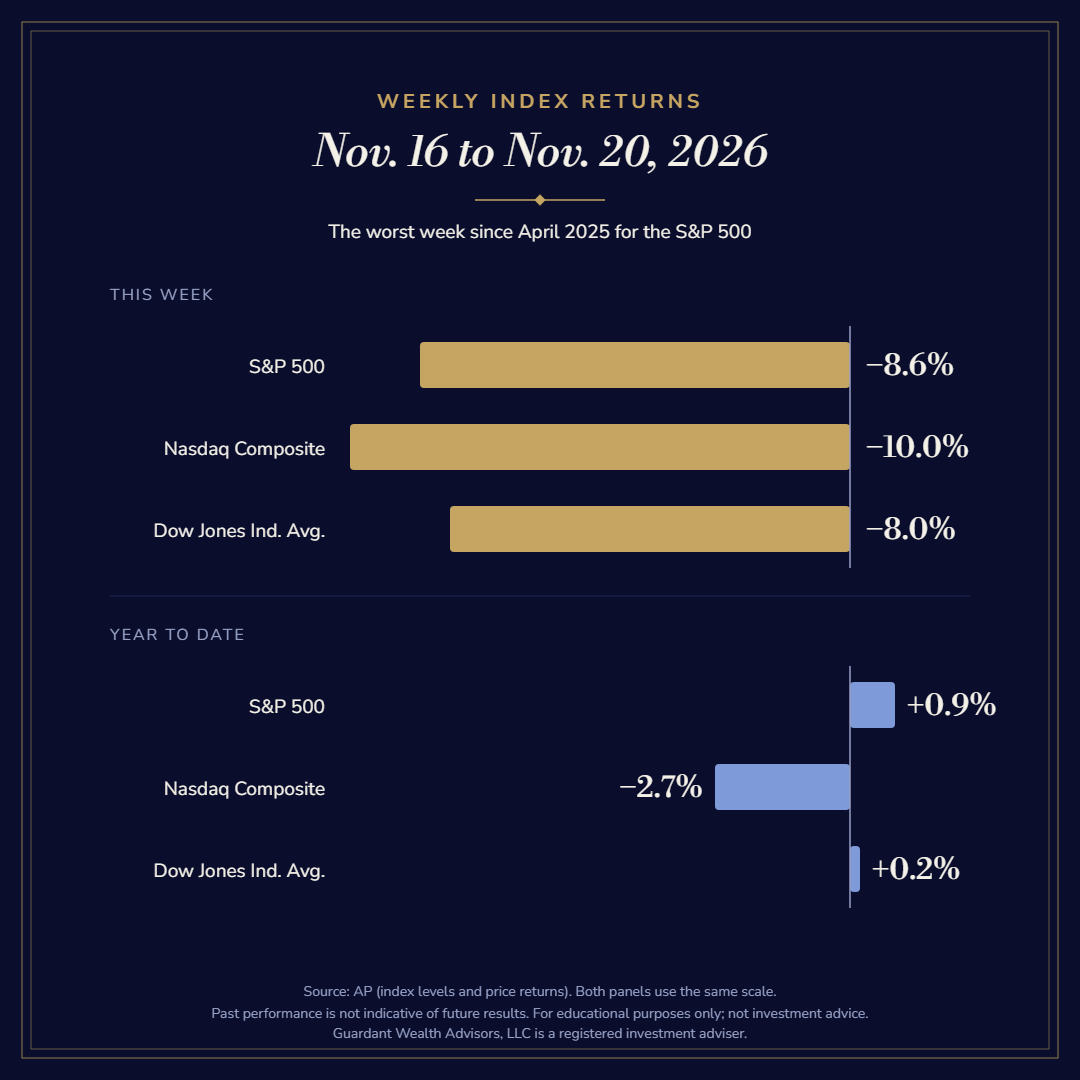
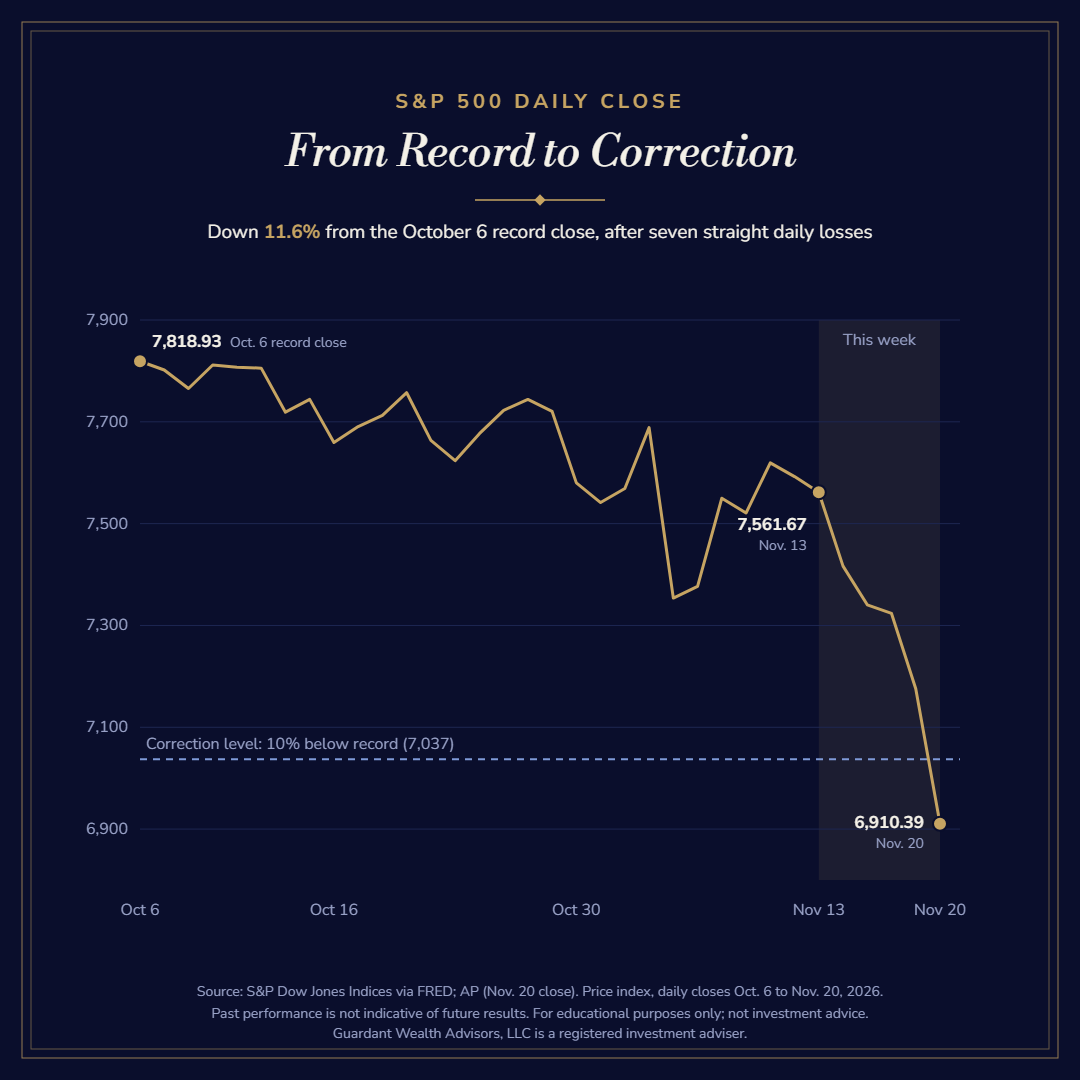
This was a difficult week for stock investors. The S&P 500 fell 8.6%, its largest weekly decline since April 2025, and closed lower for seven straight sessions. The Dow Jones Industrial Average lost 8.0%, and the Nasdaq Composite dropped 10.0%. By Friday, both the S&P 500 and the Dow had entered correction territory, a decline of more than 10% from a recent high, and the Nasdaq had turned negative for 2026.
What We Observed This Week
-
Good news did not lift the market. On Tuesday, Nvidia reported quarterly revenue of about $115.8 billion, well above analyst estimates, and issued guidance above expectations. Early gains faded within a day.
-
A landmark listing came and went. Anthropic priced the largest initial public offering (IPO) on record at $83 per share, above its expected range. Shares opened at $111.50 on Thursday but finished that day at $97.17 and slipped further on Friday.
-
Selling intensified on Friday. Technology and semiconductor stocks led the decline, with the S&P 500 falling 3.7% and the Nasdaq dropping 5.3%. Several more defensive sectors, including consumer staples, finished higher.
-
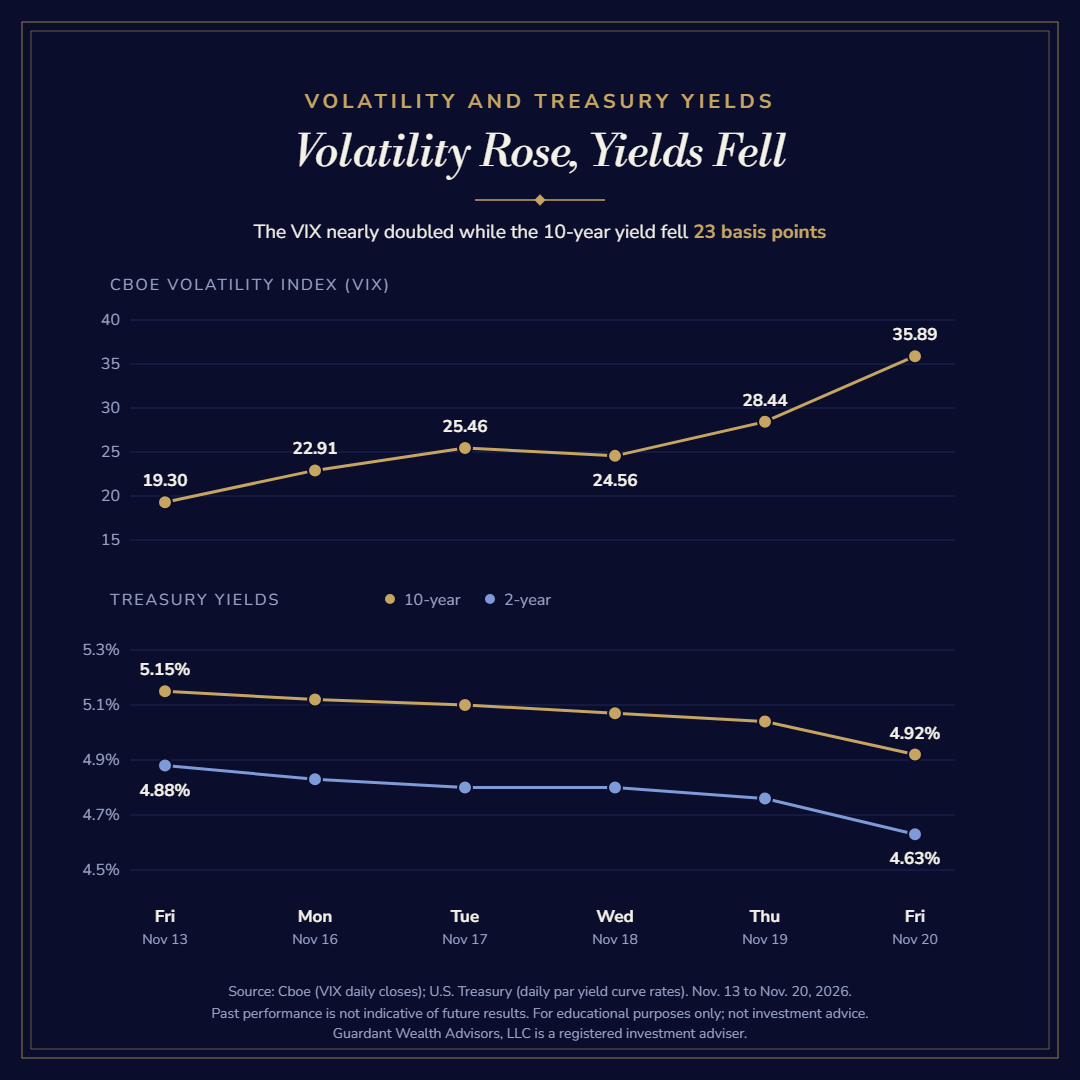
Volatility rose sharply. The Cboe Volatility Index (VIX) closed near 36, up from about 19 a week earlier.
-
Bonds acted as a cushion. The 10-year Treasury yield fell from 5.15% to 4.92%, its largest weekly decline since early April 2025, as investors sought safety. Falling yields mean rising bond prices.
-
The Federal Reserve stayed firm. Minutes from the October Federal Open Market Committee (FOMC) meeting showed that almost all participants expected further rate increases to be appropriate. Futures market pricing, as tracked by the FedWatch tool on November 20, still showed about a 92% chance of a quarter-point hike in December.
-
Oil eased again. Brent crude settled at $92.57 a barrel, down 3.4% for the week and lower for a third straight week.
What We Are Watching
-
Whether selling pressure in technology stocks broadens or begins to stabilize during the holiday-shortened Thanksgiving week.
-
How the Fed weighs tighter financial conditions from falling stock prices against inflation that remains above its 2% target ahead of the December 8-9 meeting.
-
The direction of Treasury yields, which may signal whether investors see slower growth ahead.
-
November Consumer Price Index (CPI) data on December 10.
The Long-Term Takeaway
Corrections are uncomfortable, but they are not unusual. This week showed how quickly sentiment can shift, even when the underlying business news is strong. It also showed why diversification matters: while stocks fell, high-quality bonds generally gained as yields declined. We believe periods like this are best met with a clear plan, a long-term perspective and a portfolio designed with both growth and stability in mind.
By the Numbers
Week in Numbers: Nov 13 – Nov 20, 2026
| Market measure |
Nov 13 close |
Nov 20 close |
Weekly change |
| S&P 500 |
7,561.67 |
6,910.39 |
-8.61% |
| Nasdaq Composite |
25,136.27 |
22,617.73 |
-10.02% |
| Dow Jones Industrial Average |
52,347.55 |
48,147.33 |
-8.02% |
| Cboe Volatility Index (VIX) |
19.30 |
35.89 |
+16.59 points |
| 10-Year Treasury yield |
5.15% |
4.92% |
-23 bp |
| 2-Year Treasury yield |
4.88% |
4.63% |
-25 bp |
| Brent crude, January futures ($/bbl) |
$95.84 |
$92.57 |
-3.41% |
The Week, Day by Day
| Close |
S&P 500 |
Nasdaq |
Dow |
VIX |
10-Year yield |
| Fri, Nov 13 |
7,561.67 |
25,136.27 |
52,347.55 |
19.30 |
5.15% |
| Mon, Nov 16 |
7,416.59 |
24,509.76 |
51,608.17 |
22.91 |
5.12% |
| Tue, Nov 17 |
7,340.53 |
24,328.38 |
50,759.42 |
25.46 |
5.10% |
| Wed, Nov 18 |
7,323.63 |
24,429.88 |
50,198.17 |
24.56 |
5.07% |
| Thu, Nov 19 |
7,175.83 |
23,879.20 |
49,097.06 |
28.44 |
5.04% |
| Fri, Nov 20 |
6,910.39 |
22,617.73 |
48,147.33 |
35.89 |
4.92% |
Source: S&P Dow Jones Indices and Nasdaq via FRED; AP; Cboe Global Markets; U.S. Department of the Treasury, Daily Treasury Par Yield Curve Rates; Brent futures settlements via CNBC and Dow Jones. Index levels are price-only closing values. A basis point (bp) is one hundredth of a percentage point. Past performance is not indicative of future results.
Disclaimer: This content is for educational purposes only and does not constitute personalized investment advice or a recommendation to buy or sell any security. The information provided reflects general market commentary based on publicly available information and is not tailored to the financial situation of any individual. Investing involves risk, including the possible loss of principal. Past market performance is not indicative of future results. Guardant Wealth Advisors, LLC is a registered investment adviser. Registration does not imply a certain level of skill or training.

Weekly Market Commentary: November 16 – 20, 2026
Strong Earnings and a Record IPO Could Not Stop the Worst Week Since April 2025
By Guardant Wealth Advisors
This was a difficult week for stock investors. The S&P 500 fell 8.6%, its largest weekly decline since April 2025, and closed lower for seven straight sessions. The Dow Jones Industrial Average lost 8.0%, and the Nasdaq Composite dropped 10.0%. By Friday, both the S&P 500 and the Dow had entered correction territory, a decline of more than 10% from a recent high, and the Nasdaq had turned negative for 2026.
What We Observed This Week
Good news did not lift the market. On Tuesday, Nvidia reported quarterly revenue of about $115.8 billion, well above analyst estimates, and issued guidance above expectations. Early gains faded within a day.
A landmark listing came and went. Anthropic priced the largest initial public offering (IPO) on record at $83 per share, above its expected range. Shares opened at $111.50 on Thursday but finished that day at $97.17 and slipped further on Friday.
Selling intensified on Friday. Technology and semiconductor stocks led the decline, with the S&P 500 falling 3.7% and the Nasdaq dropping 5.3%. Several more defensive sectors, including consumer staples, finished higher.
Volatility rose sharply. The Cboe Volatility Index (VIX) closed near 36, up from about 19 a week earlier.
Bonds acted as a cushion. The 10-year Treasury yield fell from 5.15% to 4.92%, its largest weekly decline since early April 2025, as investors sought safety. Falling yields mean rising bond prices.
The Federal Reserve stayed firm. Minutes from the October Federal Open Market Committee (FOMC) meeting showed that almost all participants expected further rate increases to be appropriate. Futures market pricing, as tracked by the FedWatch tool on November 20, still showed about a 92% chance of a quarter-point hike in December.
Oil eased again. Brent crude settled at $92.57 a barrel, down 3.4% for the week and lower for a third straight week.
What We Are Watching
Whether selling pressure in technology stocks broadens or begins to stabilize during the holiday-shortened Thanksgiving week.
How the Fed weighs tighter financial conditions from falling stock prices against inflation that remains above its 2% target ahead of the December 8-9 meeting.
The direction of Treasury yields, which may signal whether investors see slower growth ahead.
November Consumer Price Index (CPI) data on December 10.
The Long-Term Takeaway
Corrections are uncomfortable, but they are not unusual. This week showed how quickly sentiment can shift, even when the underlying business news is strong. It also showed why diversification matters: while stocks fell, high-quality bonds generally gained as yields declined. We believe periods like this are best met with a clear plan, a long-term perspective and a portfolio designed with both growth and stability in mind.
By the Numbers
Source: S&P Dow Jones Indices and Nasdaq via FRED; AP; Cboe Global Markets; U.S. Department of the Treasury, Daily Treasury Par Yield Curve Rates; Brent futures settlements via CNBC and Dow Jones. Index levels are price-only closing values. A basis point (bp) is one hundredth of a percentage point. Past performance is not indicative of future results.
Disclaimer: This content is for educational purposes only and does not constitute personalized investment advice or a recommendation to buy or sell any security. The information provided reflects general market commentary based on publicly available information and is not tailored to the financial situation of any individual. Investing involves risk, including the possible loss of principal. Past market performance is not indicative of future results. Guardant Wealth Advisors, LLC is a registered investment adviser. Registration does not imply a certain level of skill or training.
more posts:
Weekly Market Commentary: November 9 – 13, 2026
RIA Pulse: Firms of the Month
Weekly Market Commentary: November 2 – 6, 2026