Markets Closed the Week, but the Planning Questions Remain Open
We observed a trading week in which stock-market optimism coexisted with uncertainty in energy and government-bond markets. Friday’s closing coverage described a recovery in equities while oil prices and Treasury yields continued to move through competing signals. The important distinction is that a completed trading week does not necessarily produce a settled economic outlook.
For long-term investors, our focus is not on turning one week’s headlines into a forecast. It is on separating what happened, what remains uncertain, and which questions belong in a financial-planning discussion.
What We Observed This Week
Friday’s market reporting described uncertainty around energy supplies and the conflict involving Iran. Treasury trading also reflected competing concerns about inflation, government borrowing, and continued economic growth. Those forces can coexist rather than resolve neatly into one market narrative.
We also observed a contrast between expectations for corporate profits and pressures felt by households. The Associated Press reported that investors were looking ahead to major bank earnings while consumer survey results pointed to continuing concern about inflation. Expectations for businesses and the financial experience of households are related, but they are not interchangeable.
Our interpretation is that market commentary needs more than a headline about whether stocks rose or fell. A useful recap distinguishes corporate expectations, household conditions, and the practical decisions investors face.
None of those observations establishes what markets will do next.
What We Are Watching
We are watching whether forthcoming corporate reports provide evidence consistent with investors’ expectations. Friday’s closing coverage identified major bank reports as part of the next week’s calendar. We are treating those reports as information still to come, not conclusions already established.
We are also watching the distinction between having financial resources and being able to access them. The Financial Industry Regulatory Authority explains that certain investments can be difficult to sell quickly, while others may impose charges for early access. A household’s total assets therefore do not, by themselves, answer a near-term funding question.
This is not a recommendation to change investments in response to unsettled markets. It is a framework for understanding which commitments depend on timely access to money and which goals have more flexibility.
Long-Term Investor Takeaway
We believe the most useful planning discussion separates three questions: what is known, what is assumed, and what can be controlled.
Known information includes completed market observations. Assumptions include expectations about future income, expenses, and investment conditions. Controllable decisions may include how clearly goals are defined and how carefully obligations are mapped against available resources.
Investment allocation still involves tradeoffs. The Securities and Exchange Commission’s investor education materials connect allocation decisions to time horizon and risk tolerance. A longer horizon does not eliminate risk, and a shorter horizon does not automatically determine a single appropriate investment approach.
We are not treating this week’s market activity as a reason for urgency. Instead, we are using it to reinforce a planning discipline: distinguish market news from household needs, recognize access limitations, and keep uncertainty explicit.
A weekly recap can help organize the conversation. It cannot substitute for understanding the financial circumstances behind it.
By the Numbers
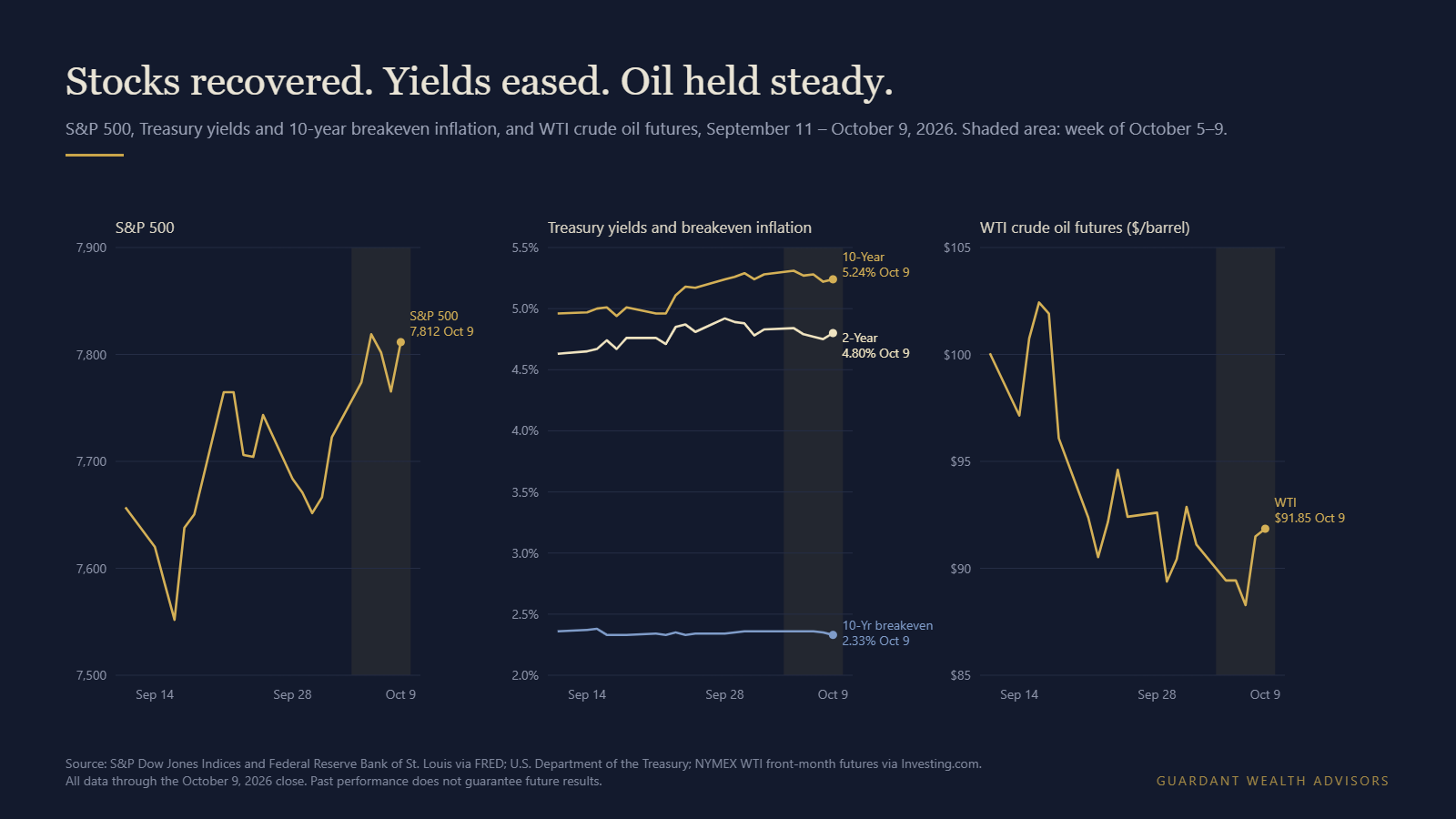
Week in Numbers: Oct 2 – Oct 9, 2026
| Market measure |
Oct 2 close |
Oct 9 close |
Weekly change |
| S&P 500 |
7,722.72 |
7,811.54 |
+1.15% |
| 10-Year Treasury yield |
5.28% |
5.24% |
-4 bp |
| 2-Year Treasury yield |
4.83% |
4.80% |
-3 bp |
| 10-Year breakeven inflation |
2.36% |
2.33% |
-3 bp |
| WTI crude, front-month futures ($/bbl) |
$91.11 |
$91.85 |
+0.81% |
Source: S&P Dow Jones Indices LLC and Federal Reserve Bank of St. Louis (10-year breakeven inflation), via FRED; U.S. Department of the Treasury, Daily Treasury Par Yield Curve Rates; NYMEX WTI front-month futures closing prices via Investing.com. All figures are as of the close on Friday, October 9, 2026. Index levels are price-only closing values; Treasury yields are end-of-day constant-maturity rates. Past performance does not guarantee future results.
Disclaimer: This content is for educational purposes only and does not constitute personalized investment advice or a recommendation to buy or sell any security. The information provided reflects general market commentary based on publicly available information and is not tailored to the financial situation of any individual. Investing involves risk, including the possible loss of principal. Past market performance is not indicative of future results. Guardant Wealth Advisors, LLC is a registered investment adviser. Registration does not imply a certain level of skill or training.

Weekly Market Commentary: October 5 – 9, 2026
Markets Closed the Week, but the Planning Questions Remain Open
We observed a trading week in which stock-market optimism coexisted with uncertainty in energy and government-bond markets. Friday’s closing coverage described a recovery in equities while oil prices and Treasury yields continued to move through competing signals. The important distinction is that a completed trading week does not necessarily produce a settled economic outlook.
For long-term investors, our focus is not on turning one week’s headlines into a forecast. It is on separating what happened, what remains uncertain, and which questions belong in a financial-planning discussion.
What We Observed This Week
Friday’s market reporting described uncertainty around energy supplies and the conflict involving Iran. Treasury trading also reflected competing concerns about inflation, government borrowing, and continued economic growth. Those forces can coexist rather than resolve neatly into one market narrative.
We also observed a contrast between expectations for corporate profits and pressures felt by households. The Associated Press reported that investors were looking ahead to major bank earnings while consumer survey results pointed to continuing concern about inflation. Expectations for businesses and the financial experience of households are related, but they are not interchangeable.
Our interpretation is that market commentary needs more than a headline about whether stocks rose or fell. A useful recap distinguishes corporate expectations, household conditions, and the practical decisions investors face.
None of those observations establishes what markets will do next.
What We Are Watching
We are watching whether forthcoming corporate reports provide evidence consistent with investors’ expectations. Friday’s closing coverage identified major bank reports as part of the next week’s calendar. We are treating those reports as information still to come, not conclusions already established.
We are also watching the distinction between having financial resources and being able to access them. The Financial Industry Regulatory Authority explains that certain investments can be difficult to sell quickly, while others may impose charges for early access. A household’s total assets therefore do not, by themselves, answer a near-term funding question.
This is not a recommendation to change investments in response to unsettled markets. It is a framework for understanding which commitments depend on timely access to money and which goals have more flexibility.
Long-Term Investor Takeaway
We believe the most useful planning discussion separates three questions: what is known, what is assumed, and what can be controlled.
Known information includes completed market observations. Assumptions include expectations about future income, expenses, and investment conditions. Controllable decisions may include how clearly goals are defined and how carefully obligations are mapped against available resources.
Investment allocation still involves tradeoffs. The Securities and Exchange Commission’s investor education materials connect allocation decisions to time horizon and risk tolerance. A longer horizon does not eliminate risk, and a shorter horizon does not automatically determine a single appropriate investment approach.
We are not treating this week’s market activity as a reason for urgency. Instead, we are using it to reinforce a planning discipline: distinguish market news from household needs, recognize access limitations, and keep uncertainty explicit.
A weekly recap can help organize the conversation. It cannot substitute for understanding the financial circumstances behind it.
By the Numbers
Source: S&P Dow Jones Indices LLC and Federal Reserve Bank of St. Louis (10-year breakeven inflation), via FRED; U.S. Department of the Treasury, Daily Treasury Par Yield Curve Rates; NYMEX WTI front-month futures closing prices via Investing.com. All figures are as of the close on Friday, October 9, 2026. Index levels are price-only closing values; Treasury yields are end-of-day constant-maturity rates. Past performance does not guarantee future results.
Disclaimer: This content is for educational purposes only and does not constitute personalized investment advice or a recommendation to buy or sell any security. The information provided reflects general market commentary based on publicly available information and is not tailored to the financial situation of any individual. Investing involves risk, including the possible loss of principal. Past market performance is not indicative of future results. Guardant Wealth Advisors, LLC is a registered investment adviser. Registration does not imply a certain level of skill or training.
more posts:
Weekly Market Commentary: September 21 – 25, 2026
Weekly Market Commentary: September 14 – 18, 2026
Student of the Market: September 2026